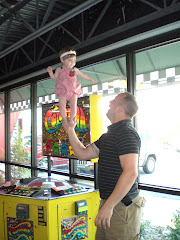
This month's entry is an excerpt from Danny Holland's book Reaching Teens in their Natural Habitat. pg 53-55
Love
"It's no secret that our kids need to know we care about them. Telling them that we love them is good, but communicating the message with our actions is even better. When I was a young baseball player, I wanted to pitch. With my dad's encouragement, I asked my coach if I coule try pitching. The coach answered, "You can't pitch. You ain't got no arm." I was disappointed. Several weeks later my father and I went to the store, where he purchased a catcher's mitt, a new basebal and a home plate. My dad informed me that he had permission to use the school gym every Tuesday and Thursday night and that he would teach me to pitch. Two days a week my father took me up to the school and let me pitch to him. I knew he had other things he wanted and needed to do, but he made sure to be there with me week after week.
The next year I pitched my first no-hitter in a tournament game against the same coach who had said I didn't have an arm. I got the game ball, and my dad wrote on it in marker, "He ain't got no arm." And to this day I have our home plate in my office. It symbolizes an act of extravagant love. It also reminds me that there are no shortcuts to making my boys know they are special to me.
Parents occasionally ask, "Danny, how do I tell my daughter I love her? I don't know what to do." Dads, remember when you were dating your wife: Remember how anemic the words "I love you" felt compared to what was in your heart? If you were anything like me, you would look for all kinds of ways to communicate your love for her, and you knew what to do because she captivated you and you studied her. We need to study our kids and look for opportunities to demonstrate our love for them. Handing over a credit card to make up for not spending time with them might bring some excitement, but no material items can fill the void within them that is designed for thei parents' love."
Bishop T.D. Jakes writes, "Start today to act like a gourmet chef. Carefully and with love, mix all your ingredients together. Stir that pot with compassion and understanding, and season the mix with support, encouragement, and respect. Don't neglect it; it might boil over or burn. Instead, tend to the pot with a watchful eye, let it simmer gently, and the flavors will blend, creating a dish fit for a king."
Monday, March 2, 2009

Thursday, February 5, 2009
Parent Education - February
This month's entry is from the book Reaching Teens in Their Natural Habitat by Danny Holland.
In one of his earlier chapters, Mr. Holland discussed the impact that television, internet, video games and music have on our children. He addressed the issue saying that parents need to monitor what their kids are watching, experiencing and listening to as the effects of being exposed to different media is alarming. Below is an excerpt from his book regarding video games.
"Nearly three out of four school-aged kids have a video-game system, which they play for about forty-nine minutes per day. And let me tell you, games today are not at all like PONG.
Grand Theft Auto recently passed Super Mario Brothers as the most popular video game of all time. It involves much more than stealing cars and driving around. The games in this series simulate criminal life. Players start as low-level criminals and progress to kingpin status. Along the way they have sex with, beat up, and kill prostitutes, and they kill other people with a variety of weapons including a golf club, a knife, a chain saw, a gun and fire. It even allows players to advertise their destructive deeds through tattoos in the exact same way real gangs use tattoos to communicate their criminal accomplishments.
The impact these games are having on our kids is still being researched. We do know, though, that video games have been used since the Vietnam War era to train our soldiers and that school shooters often do exactly as they have trained on their home simulators. In Jonesboro, Arkansas, for example, two middle-school students pulled a fire alarm, set up a military kill zone and opened fire on students and faculty. The military strategy they used was from a video game they loved to play called Soldier of Fortune. How can we justify marketing such video games both to our military for training in combat and to our kids for entertainment?"
The games he mentioned in his book are not new, however, it shows you a glimpse of what is out there to influence our kids. He offers six things parents can do to direct their teen's attention.
They are:
1. Recognize that distractions destroy dreams.
2. Train your kids and teens to guard their own focus. Only your kids can protect themselves.
3. Control the type of music, media, and teen entertainment that your kids are exposed to.
4. Starve wrong relationships. It only takes one person to destroy their future.
5. Allow and encourage relationships that enhance their focus on their life purpose.
6. If it doesn't feed, fuel, or fertilize positive focus, forget it.
In one of his earlier chapters, Mr. Holland discussed the impact that television, internet, video games and music have on our children. He addressed the issue saying that parents need to monitor what their kids are watching, experiencing and listening to as the effects of being exposed to different media is alarming. Below is an excerpt from his book regarding video games.
"Nearly three out of four school-aged kids have a video-game system, which they play for about forty-nine minutes per day. And let me tell you, games today are not at all like PONG.
Grand Theft Auto recently passed Super Mario Brothers as the most popular video game of all time. It involves much more than stealing cars and driving around. The games in this series simulate criminal life. Players start as low-level criminals and progress to kingpin status. Along the way they have sex with, beat up, and kill prostitutes, and they kill other people with a variety of weapons including a golf club, a knife, a chain saw, a gun and fire. It even allows players to advertise their destructive deeds through tattoos in the exact same way real gangs use tattoos to communicate their criminal accomplishments.
The impact these games are having on our kids is still being researched. We do know, though, that video games have been used since the Vietnam War era to train our soldiers and that school shooters often do exactly as they have trained on their home simulators. In Jonesboro, Arkansas, for example, two middle-school students pulled a fire alarm, set up a military kill zone and opened fire on students and faculty. The military strategy they used was from a video game they loved to play called Soldier of Fortune. How can we justify marketing such video games both to our military for training in combat and to our kids for entertainment?"
The games he mentioned in his book are not new, however, it shows you a glimpse of what is out there to influence our kids. He offers six things parents can do to direct their teen's attention.
They are:
1. Recognize that distractions destroy dreams.
2. Train your kids and teens to guard their own focus. Only your kids can protect themselves.
3. Control the type of music, media, and teen entertainment that your kids are exposed to.
4. Starve wrong relationships. It only takes one person to destroy their future.
5. Allow and encourage relationships that enhance their focus on their life purpose.
6. If it doesn't feed, fuel, or fertilize positive focus, forget it.
Tuesday, January 13, 2009
Parent Education - January
This is an exerpt from Reaching Teens in their Natural Habitat by Danny Holland.
VOICES OF INFLUENCE
Increased Time = Increased Strength (pgs 27-28)
Whatever you look at most will gain strength and eventually be the strongest attraction in your life. Let me give you an example. I used to have a fascination with Jeeps. I loved looking at Jeeps, checking out the modifications Jeep owners made, and even studying the Jeep concept vehicles. I would dream of taking my new Jeep Rubicon top down, wife and kids strapped in, onto the beach and giving its thirty-three-inch B.F. Goodrich Mud Terrain tires a workout as waves crashed around us. You get the picture. The more I dreamed about having a Jeep, the more often Jeeps caught my eye. I noticed every Jeep that passed me even when I was driving on the interstate at seventy-five miles per hour. By allowing Jeeps to repeatedly capture my attention, I unintentionally trained my eye to notice them.
And what captures our attention is not as important as what keeps it. So study and be an expert in whatever keeps your child's attention. It might be something educational and positive. It might even give you a clue as to what your child's purpose is in life. It might be a musical instrument, sport, or civic or church activity. And once you find that captivating item or activity, go out of your way to feed that source of attention.
While I was growing up, my father was the news director of a popular radio station, but he was laid off when the ownership changed. I was a teenager at the time, and suddenly I became interested in playing the bass guitar. I had a cheap one, but I quickly outgrew it. After nearly twenty months, my father had not found a job. But even though money was tight, he made a huge investment in my future by buying me an eighteen-hundred-dollar instrument and a thousand dollars worth of accessories for Christmas. I understand something today that I didn't know then: my father saw my attention and energy being drawn toward something positive, and he fed that source of attention. Even though some might see his purchase as a poor financial decision for a man in his position, he saw my interest as the opportunity of a lifetime. It's been said that the opportunity of a lifetime must be seized during the lifetime of the opportunity, and that is never truer than when it comes to our kids and their interests.
VOICES OF INFLUENCE
Increased Time = Increased Strength (pgs 27-28)
Whatever you look at most will gain strength and eventually be the strongest attraction in your life. Let me give you an example. I used to have a fascination with Jeeps. I loved looking at Jeeps, checking out the modifications Jeep owners made, and even studying the Jeep concept vehicles. I would dream of taking my new Jeep Rubicon top down, wife and kids strapped in, onto the beach and giving its thirty-three-inch B.F. Goodrich Mud Terrain tires a workout as waves crashed around us. You get the picture. The more I dreamed about having a Jeep, the more often Jeeps caught my eye. I noticed every Jeep that passed me even when I was driving on the interstate at seventy-five miles per hour. By allowing Jeeps to repeatedly capture my attention, I unintentionally trained my eye to notice them.
And what captures our attention is not as important as what keeps it. So study and be an expert in whatever keeps your child's attention. It might be something educational and positive. It might even give you a clue as to what your child's purpose is in life. It might be a musical instrument, sport, or civic or church activity. And once you find that captivating item or activity, go out of your way to feed that source of attention.
While I was growing up, my father was the news director of a popular radio station, but he was laid off when the ownership changed. I was a teenager at the time, and suddenly I became interested in playing the bass guitar. I had a cheap one, but I quickly outgrew it. After nearly twenty months, my father had not found a job. But even though money was tight, he made a huge investment in my future by buying me an eighteen-hundred-dollar instrument and a thousand dollars worth of accessories for Christmas. I understand something today that I didn't know then: my father saw my attention and energy being drawn toward something positive, and he fed that source of attention. Even though some might see his purchase as a poor financial decision for a man in his position, he saw my interest as the opportunity of a lifetime. It's been said that the opportunity of a lifetime must be seized during the lifetime of the opportunity, and that is never truer than when it comes to our kids and their interests.
Monday, January 12, 2009
Upcoming Trips and Events
CHAPERONES NEEDED
Tuesday, January 13, we will be accepting registrations at the office for the 6th and 7th grade class trips as well as the new 8th grade trip to the City Museum in St. Louis.
6TH GRADE - CREATION MUSEUM
-The cost for the students this year is $70. We will only be taking one coach so chaperones will need to drive or carpool. The cost for chaperones is $30 plus your driving expenses. There is no limit to the number of chaperones.
7TH GRADE - APPALACHIA MISSION TRIP
-The cost for the students this year is $140. We will only be taking one coach so chaperones will need to drive or carpool. The cost for chaperones is $70 plus your driving expenses. There is no limit to the number of chaperones.
CITY MUSEUM - 8TH GRADE END OF YEAR TRIP
-There is 8 spots available for chaperones on this trip. This is a day trip leaving bright and early in the morning and returning around 8pm on May 20. The cost is $32. Registration will also start Tuesday, January 13. Chaperone registration for this trip is first come first serve.
HOLIDAY WORLD TICKETS FOR MAY 20
-If you plan on attending Holiday World on May 20 with your 7th grader, you may purchase a ticket through the school at a discounted rate. The student price for the trip is $25, including the ticket and travel. The adult price is $20 as you must drive yourself to the venue. Tickets must be paid for when you order them at the office. The last day to order tickets is Friday, February 6.
Tuesday, January 13, we will be accepting registrations at the office for the 6th and 7th grade class trips as well as the new 8th grade trip to the City Museum in St. Louis.
6TH GRADE - CREATION MUSEUM
-The cost for the students this year is $70. We will only be taking one coach so chaperones will need to drive or carpool. The cost for chaperones is $30 plus your driving expenses. There is no limit to the number of chaperones.
7TH GRADE - APPALACHIA MISSION TRIP
-The cost for the students this year is $140. We will only be taking one coach so chaperones will need to drive or carpool. The cost for chaperones is $70 plus your driving expenses. There is no limit to the number of chaperones.
CITY MUSEUM - 8TH GRADE END OF YEAR TRIP
-There is 8 spots available for chaperones on this trip. This is a day trip leaving bright and early in the morning and returning around 8pm on May 20. The cost is $32. Registration will also start Tuesday, January 13. Chaperone registration for this trip is first come first serve.
HOLIDAY WORLD TICKETS FOR MAY 20
-If you plan on attending Holiday World on May 20 with your 7th grader, you may purchase a ticket through the school at a discounted rate. The student price for the trip is $25, including the ticket and travel. The adult price is $20 as you must drive yourself to the venue. Tickets must be paid for when you order them at the office. The last day to order tickets is Friday, February 6.
Wednesday, December 17, 2008
Parent Education - December 08
The following are disciplinary techniques to consider from the book Getting it Right with Children written by Madelyn Swift.
Disciplinary consequences
- Consequences should be fair, reasonable, direct and related to the behavior.
- Don't ask, "Do you understand?" Instead, have them repeat what you said.
- Use words to help you get a point across. For example, say, "you need to pick things up" not "I need you to pick things up."
Direct child to remedy or amends
- "The paint is spilled on the floor. The sponges are in the cabinet."
Problem? Think!
- Help guide your kids through alternatives and problem solving. Do not abandon children who have not developed problem solving skills.
Take action
- Be sure to follow through on what you say. Discipline doesn't have to be damaging, but it has to be definite.
Use Humor
-Humor: either you have it or you must develop it. Humor is situational.
Disciplinary consequences
- Consequences should be fair, reasonable, direct and related to the behavior.
- Don't ask, "Do you understand?" Instead, have them repeat what you said.
- Use words to help you get a point across. For example, say, "you need to pick things up" not "I need you to pick things up."
Direct child to remedy or amends
- "The paint is spilled on the floor. The sponges are in the cabinet."
Problem? Think!
- Help guide your kids through alternatives and problem solving. Do not abandon children who have not developed problem solving skills.
Take action
- Be sure to follow through on what you say. Discipline doesn't have to be damaging, but it has to be definite.
Use Humor
-Humor: either you have it or you must develop it. Humor is situational.
Wednesday, December 3, 2008
8th grade Holiday World changed to St. Louis City Museum
The 8th grade Holiday World trip on May 20 is being changed. The 8th graders will now be going to the St. Louis City Museum. It is not your conventional museum but an entire building filled with caves, secret passage ways, climbing, seven story slides and more! We will leave early in the morning and return late evening (8pm). The following day is their last day and graduation. The students will love the museum. It will be a blast! Check out their website at www.citymuseum.org.
Merits vs. Demerits
I want to clear up the difference between merits and demerits in Renweb, as many parents have mistaken a merit for a demerit. I apologize for the confusion. Let me take a minute to explain the difference between the two. A demerit is a consequence for student behavior that is against the policies of ECS. A demerit accumulates for the year and removes them from the discipline free trip each quarter. In most cases a demerit is given, the parents are called to notify them of the incident that took place involving their child. A merit is simply a way for ECS to track student behavior. Every behavior incident entered in the computer is emailed to me. I then look at the child's history to check for patterns or issues. One child, for instance, might have gum in first, second, third and fourth periods (4 different incidences). Each teacher tells the student to get rid of it and logs it in as a merit. The teachers in periods 2-4 don't know that the student has already been warned by the previous teachers. In a case like this, gum is not the issue. The student is being disobedient. It is important to know that merits do not dismiss a child from the discipline free trip each quarter. Thank you for your patience with the new system. We are working very hard to make it as smooth as we can. I have heard mostly good things about it from you, the parents, and we believe it will only get better.
Subscribe to:
Posts (Atom)